


en
en v
Phone
Cart0 Tickets
Total: 0
Account
Calendar
Search
Menu

Wednesday From Light

VenueDeutsche Oper Berlin
CalendarSat 19 Sep 2026 - Sun 27 Sep 2026
Synopsis/Details


On the occasion of the new directorship, Deutsche Oper Berlin is venturing to show a project that crashes through boundaries and opens up new spaces: Karlheinz Stockhausen’s Mittwoch aus Licht will be shown as a scenic opera production in the German-speaking world for the first time. Stockhausen, visionary of sound, crafted nothing less than a cosmic theatrum mundi about man and woman, good and evil, birth and death with his monumental cycle LICHT. Die sieben Tage der Woche. While other portions of the cycle centre around the struggle between competing forces, the polarity of which reshapes our lives every day, Mittwoch celebrates the utopia of love and the spiritual connection in the spirit of music, as well as the belief that community and solidarity are possible. Stockhausen was uncompromising in his search for a new type of music; he is considered one of the most innovative and yet most controversial composers of the 20th century. A pioneer of electronic music, he also inspired pop music across all genres, including Kraftwerk and Björk. The spectacular centrepiece of Mittwoch aus Licht is the helicopter string quartet, in which Stockhausen expands the musical space beyond the theatre itself: The members of a string quartet sit in four helicopters circling high above the audience. Sounds of strings meld with the helicopter blades, floating down to the audience from above. For our production, the quartet will be performed live as a one-of-a-kind event for the whole city, with film recordings of the quartet becoming part of the production. Award-winning duo Susanne Kennedy and Markus Selg, who caused a sensation with Einstein on the Beach at Theater Basel and Parsifal at Opera Antwerpen, will transform their first opera production in Berlin into an immersive ritual. Maxime Pascal, Principal Guest Conductor under the new directorship, is an expert and passionate connoisseur of Stockhausen and has performed every piece of the LICHT cycle except for Mittwoch.

Introduction: 45 minutes before the performance in the Rang Foyer on the right

Language: In German language with German and English surtitles

Duration: approx. 4 hours / incl. break

Age recommendation: from age 14

Co-production: With generous support from the Förderkreis der Deutschen Oper Berlin and the Lotto Foundation Berlin. A co-production with the Philharmonie de Paris. In cooperation with Berliner Festspiele / Musikfest Berlin.

Cast

Team

Conductor: Maxime Pascal

Director: Susanne Kennedy

Stage design: Markus Selg

Costume design: Andra Dumitrascu

Light design: Marcel Weber

Sound design: Florent Derex

Video: Markus Selg; Warja Rybakova

Dramaturgy: Beate Breidenbach

Chorus direction Weltparlament: Jeremy Bines


Cast

Operator: N. N.

Performer:

Chorus

Musicians

String quartet of the orchestra of the Deutsche Oper Berlin: 

Venue
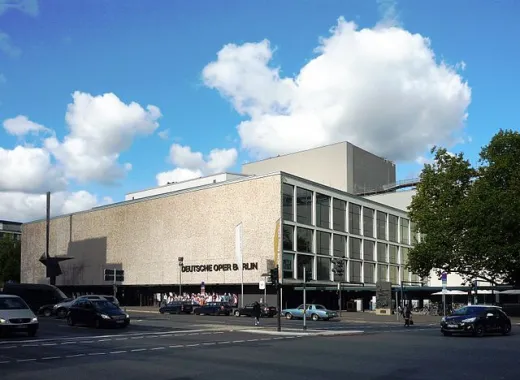
Deutsche Oper Berlin

The Deutsche Oper Berlin is an opera company located in the Charlottenburg district of Berlin, Germany. The resident building is the country's second largest opera house and also home to the Berlin State Ballet.

The company's history goes back to the Deutsches Opernhaus built by the then independent city of Charlottenburg—the "richest town of Prussia"—according to plans designed by Heinrich Seeling from 1911. It opened on November 7, 1912 with a performance of Beethoven's Fidelio, conducted by Ignatz Waghalter. After the incorporation of Charlottenburg by the 1920 Greater Berlin Act, the name of the resident building was changed to Städtische Oper (Municipal Opera) in 1925.


Deutsches Opernhaus, 1912
With the Nazi Machtergreifung in 1933, the opera was under control of the Reich Ministry of Public Enlightenment and Propaganda. Minister Joseph Goebbels had the name changed back to Deutsches Opernhaus, competing with the Berlin State Opera in Mitte controlled by his rival, the Prussian minister-president Hermann Göring. In 1935, the building was remodeled by Paul Baumgarten and the seating reduced from 2300 to 2098. Carl Ebert, the pre-World War II general manager, chose to emigrate from Germany rather than endorse the Nazi view of music, and went on to co-found the Glyndebourne opera festival in England. He was replaced by Max von Schillings, who acceded to enact works of "unalloyed German character". Several artists, like the conductor Fritz Stiedry or the singer Alexander Kipnis followed Ebert into emigration. The opera house was destroyed by a RAF air raid on 23 November 1943. Performances continued at the Admiralspalast in Mitte until 1945. Ebert returned as general manager after the war.

After the war, the company in what was now West Berlin used the nearby building of the Theater des Westens until the opera house was rebuilt. The sober design by Fritz Bornemann was completed on 24 September 1961. The opening production was Mozart's Don Giovanni. The new building opened with the current name.


Accomodation

Buy now

Gift vouchers

Gift someone an unforgettable night at the opera.
Choose a gift coupon and let them pick the performance they love—music, drama, and world-class artistry, all in one elegant experience.
Berlin Opera Tickets
Facebook
Payment
Ticket search
Google Play
App Store
© 2026 RM EUROPA TICKET GmbH
Whatsapp