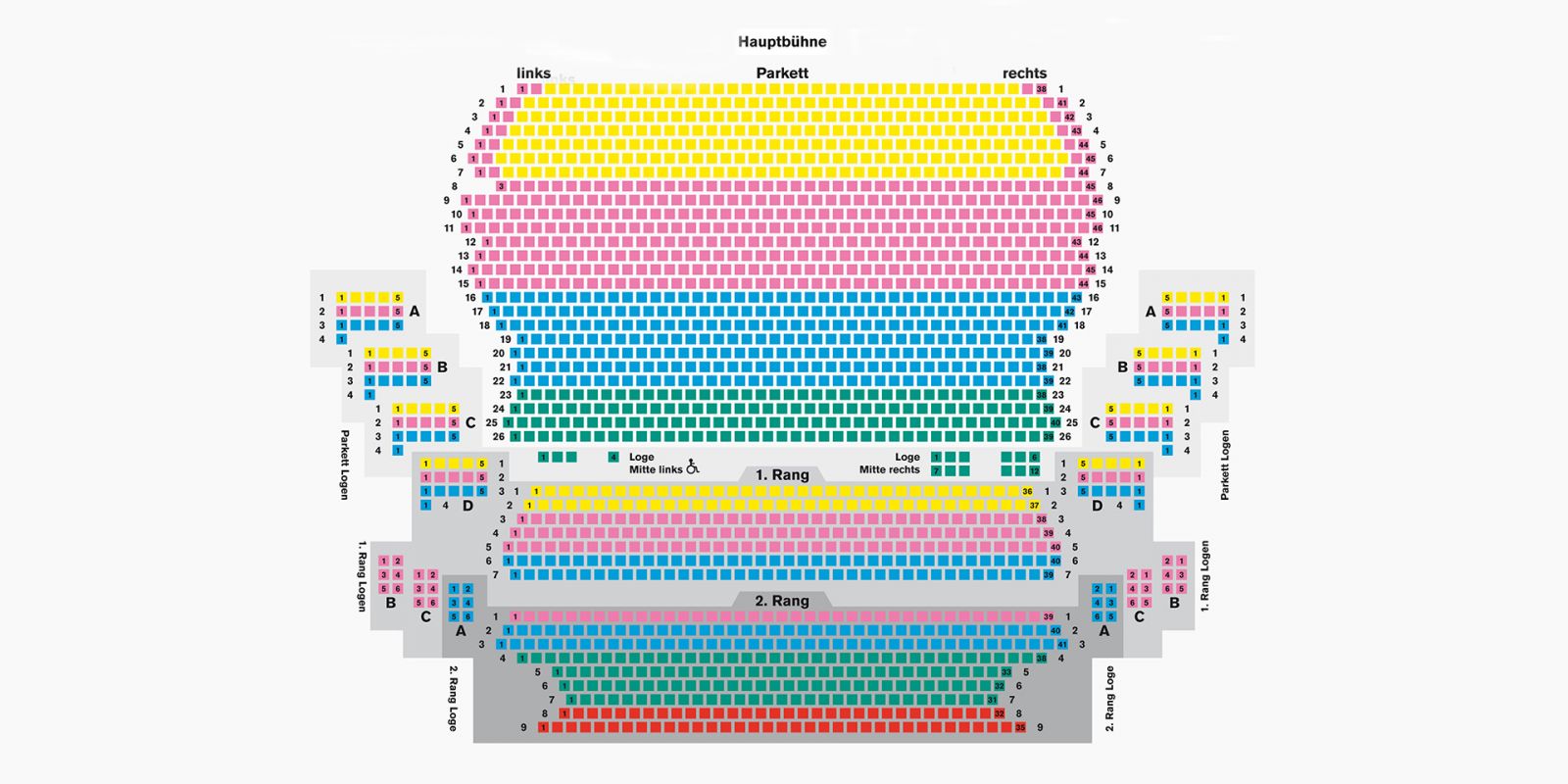
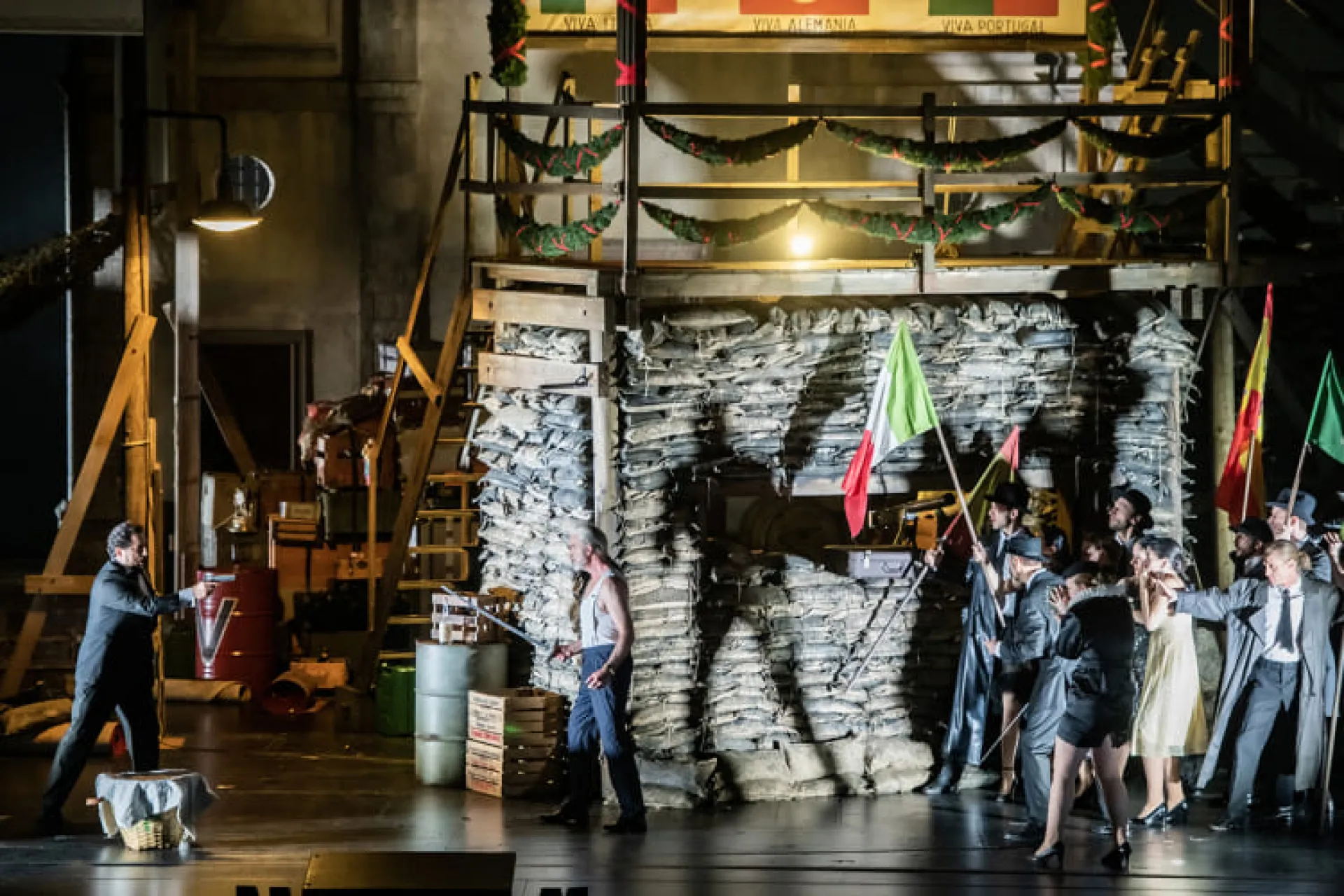
With La forza del destino, Verdi broke new ground in the 1860s. The title itself refers to this paradigm shift, as it does not refer to the name of a character or a historical event, but rather evokes the universal concept of the «power of fate». Accordingly, the composer wrote a four-act opera that is a drama of ideas, dealing with the fate of entire social classes and peoples. Building on this, director Frank Castorf creates connections to the Spanish Civil War of the 20th century and the fight against fascism in the Second World War, weaving the individual fates of the characters with the horrors of colonial history. In this production by the veteran enfant terrible of the Berlin theatre scene, the «triangle of fate» is embodied this time by an internationally sought-after trio consisting of Guanqun Yu (Leonora) and the two house debutants Luciano Ganci (Don Alvaro) and Igor Golovatenko (Don Carlos). Massimo Zannetti, a frequent guest at the Berlin State Opera in the past, makes his debut at the Deutsche Oper with this revival.
Synopsis
Place: Spain and Italy
Time: around 1750
Overture
The music begins with the opera's "Fate" motif, an ominous three note E unison in the brass.
Act 1
he mansion of Leonora's family, in Seville
Don Alvaro, a young nobleman from South America (presumably Peru), has settled in Seville, Spain, where he is looked down on by many because of his Inca background. There, he and Donna Leonora, the daughter of the haughty Marchese di Calatrava,[10] have fallen in love. But her father the Marchese violently opposes a match he feels is dishonorable and beneath her, believing her to have been seduced. Notwithstanding her tender regard for her father, who until now has always been kind to her, Leonora is ready to give up family and country in order to elope with Alvaro. Aided by her confidante, Curra (Me pellegrina ed orfana – "Exiled and orphaned far from my childhood home"), she prepares to leave.
When Alvaro arrives to fetch her, however, Leonora hesitates, begging for one last day with her father. Alvaro, stunned, releases her from their engagement, saying that she cannot love him as much as he loves her. Leonora then relents and they agree to escape as planned. At that moment the Marchese suddenly enters and discovers the couple together. Assuming the worst, he draws his weapons and threatens the young man with death. To remove any suspicion as to Leonora's purity, Alvaro surrenders himself. As he flings down his pistol, it goes off, mortally wounding the Marchese, who dies, uttering a curse on his daughter. The horrified lovers rush out of the room.
Act 2
Scene 1: An inn in the village of Hornachuelos
About a year has passed since the death of the Marchese di Calatrava. In their flight, Leonora and Alvaro were separated and have lost track of each other, unable to reunite or learn of each other's whereabouts.
The act opens in the crowded dining room of an inn, where the guests include the alcalde (town mayor) and several muleteers among others gathered in the dining room as dinner is about to be served. Leonora's brother Don Carlo di Vargas then enters, bent on avenging the family honor and the death of his father. Carlo has disguised himself as a student from Salamanca by the name of Pereda. During the supper, Preziosilla, a pretty gypsy fortune teller, joins them and sings a song urging them to enlist in the army (Al suon del tamburo – "When side drums rattle") for Italy's freedom.[a] Leonora arrives in male attire accompanied by Trabuco, a muleteer, on their way to a Franciscan monastery where Leonora plans to seek refuge. Recognizing her brother, who she knows wants to kill her, she hides. Carlo grills Trabuco about the identity of his traveling companion, but the company lets him know they don't like his prying questions. They turn the tables by asking Carlo who he is. He claims to be a University student helping a friend track down the friend's sister and her seducer, who, he claims has returned to his native America (Son Pereda son ricco d'onore – "I am Pereda, of honorable descent"). The gypsy girl laughs and says she doesn't believe this story. Overhearing this, Leonora realizes that Alvaro is still alive. She concludes he has betrayed and abandoned her, and she slips away without being discovered.
Scene 2: A monastery nearby
Outside the monastery of the Madonna of Angels, Leonora, seeking sanctuary and solitary atonement, has come to take refuge in the monastery intending to live the rest of her life as a hermit (Son giunta! Grazie, o Dio! Estremo asil quest'è per me! ... Madre, pietosa Vergine, – "I've arrived! Thank heaven! My last resort and hope"... "Mother, merciful Virgin".) After a somewhat surly reception by Fra Melitone, she tells the abbot, Padre Guardiano, her true name and her wish to spend the remainder of her life in the monastery's hermitage. The abbot recounts the trials she will have to undergo. Padre Guardiano agrees to direct her to a secret cave in the mountains, where he alone will bring her food and where she will find a bell which she is to ring only in times of great danger or if she is on the point of death. Leonora, Padre Guardiano, Fra Melitone, and the other monks join in prayer as she is formally accepted as tenant of the hermitage.
Act 3
Scene 1: A forest near Velletri, in Italy
Meanwhile, Alvaro, believing Leonora to be dead, has joined the Spanish army under the name of Don Federico Herreros and has distinguished himself for bravery (La vita è inferno all'infelice ... O tu che in seno agli angeli – "Life is a hell to an unhappy man." ... "Oh, you who dwell with the angels"). He is interrupted by cries for help and rescues a man from two assassins. It is Don Carlo, who has newly joined the same regiment, also under an assumed name: Don Felice de Bornos. The two become friends and march off side by side to fight in the Battle of Velletri, a historical event which occurred in 1744.
Scene 2: The officers' quarters
Alvaro is brought into the officers' quarters, gravely wounded in the chest. As he is seemingly about to die, he entrusts the key to a casket to his friend "Don Felice" (Carlo). The box contains a packet of letters, which Alvaro says contain a secret. He makes his friend swear to burn them without reading them: (Solenne in quest'ora – "Swear to me in this solemn hour"). Felice/Carlo assures Alvaro that he won't die and that he will be decorated with the Order of Calatrava for his bravery. At the name Calatrava Alvaro shudders and exclaims, "Never!". Carlo is taken aback. He is afraid that "Don Federico" (Alvaro) may be the mysterious seducer who killed his father. He resolves to look at the letters to settle his doubts. (Morir! Tremenda cosa! ... Urna fatale del mio destino – "To die! An immense thing... Begone, fatal vessel of my destiny!"). As his wounded friend is taken away on the surgeon's stretcher, he opens the casket, finds his sister's portrait, and realizes Alvaro's true identity. At that moment a surgeon brings word that Don Alvaro may recover. Don Carlo exults at the prospect of avenging his father's death.
Scene 3: A camp near the battleground
Having recovered, Alvaro is confronted by Carlo. They begin to duel, but are separated by a passing patrol. As they restrain Carlo, the anguished Don Alvaro vows to enter a monastery.
The soldiers gather. Trabucco, the peddler, tries to sell them his wares; Fra Melitone chastises them for their godless ways; and Preziosilla leads them in a chorus in praise of the military life (Rataplan, rataplan, della gloria – "Rum-tum-tum on the drum is the music that makes a soldier's martial spirit rise").
Act 4
Scene 1: The monastery
Impoverished peasants from the region approach Fra Melitone at the monastery at Hornachuelos for food and Padre Guardiano gently scolds Melitone for his less than charitable behavior towards them. Don Carlo then approaches, having learned of the presence of Don Alvaro there. Under the name of Father Raphael, Alvaro has indeed entered the monastery, near which is Leonora's cave. Alvaro offers peace, but when Carlo taunts him as a half-breed Alvaro takes up the challenge and the two rush from the monastery. (Le minacce, i fieri accenti – "May the winds carry off with them").
Scene 2: A desolate spot near Leonora's hermitage
Leonora, longing for the peaceful release of death, restates her love for Alvaro and begs God for peace. (Pace, pace, mio Dio! – "Peace, O mighty Father, give me peace!"). The duel between the two men spills over onto the neighboring crags in the vicinity of Leonora's isolation. Upon hearing the clashing of swords she takes refuge in her cave. Carlo is mortally wounded by Alvaro, who invades the hermit's sanctuary to request the last offices for the dying man. Leonora and Alvaro recognize each other. Alvaro tells her of what has happened, and she rushes to embrace her dying brother. As she bends over him, he stabs her in the heart. The Father Superior, who has come in answer to Leonora's alarm bell, orders Alvaro to stop cursing fate and to humble himself before God. The dying Leonora joins him in this plea, and Alvaro declaims that he is now redeemed.
[Original version: Overcome by the guilt of having killed or caused the death of all the Calatravas, Alvaro jumps to his death into the nearby ravine, cursing humankind, over the protests of Father Guardiano].
 en
en 
 de
de it
it fr
fr es
es ru
ru jp
jp ro
ro







 Deutsche Oper Berlin
 Thu 08 Oct 2026 - Sun 18 Oct 2026



 RM EUROPA TICKET GmbH
 Call now
 Book now