Music from Jacques Offenbach
Text from Jules Barbier
Duration: approx. 3:30 h including two intervals
Language: Performed in French with German and English surtitles
Recommended age: 16 and up
Jacques Offenbach composed more than 100 operas and operettas, most of them with unique wit and biting satire, original and inspired. At the end of his illustrious career in Paris, which stretched over five decades, he turned to his most ambitious operatic work Les Contes d’Hoffmann (The Tales of Hoffmann), an opéra fantastique based on a play that premiered in 1881.
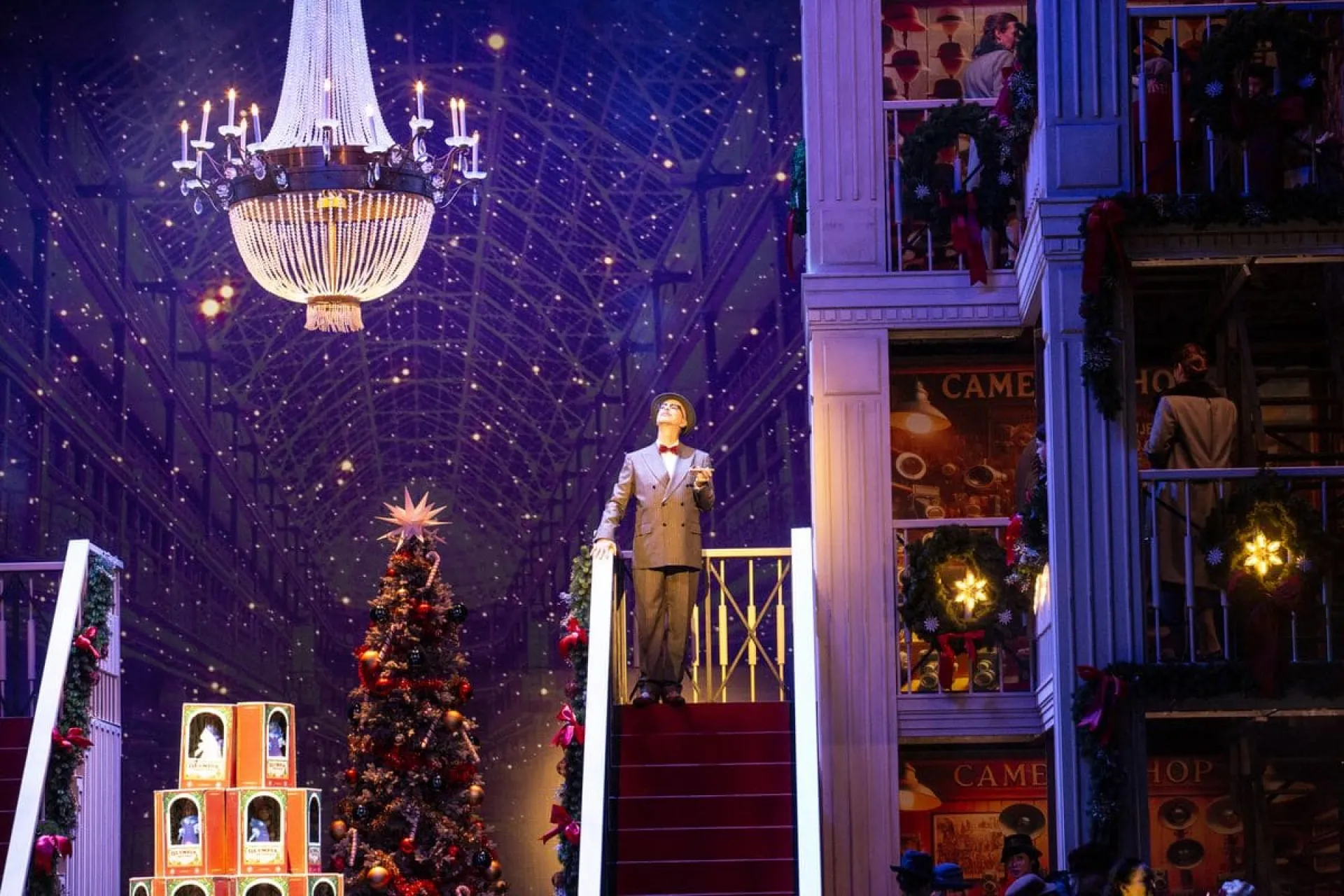
The audience is immersed in a world full of odd characters and situations, fantastic elements with several demonic, breathtaking moments and a vital, rich score. The title character, modelled on the complex Romantic writer E.T.A. Hoffmann, finds himself among his own stories, fascinated equally by art and by love, attracted by the female characters and duped by his rivals. Director Lydia Steier with her team and the conductor Bertrand de Billy will collaborate to produce an opulent scenic and musical realization.
Synopsis
Prologue
A tavern in Nuremberg: The Muse appears and reveals to the audience her purpose is to draw Hoffmann's attention and make him abjure all his other loves, so he can be devoted only to her: poetry. She takes the appearance of Hoffmann's closest friend, Nicklausse. The prima donna Stella, performing Mozart's Don Giovanni, sends a letter to Hoffmann, requesting a meeting in her dressing room after the performance. The letter and the key to the room are intercepted by Councillor Lindorf ("Dans les rôles d'amoureux langoureux" – In the languid lovers' roles), the first of the opera's incarnations of evil, Hoffmann's Nemesis. Lindorf intends to replace Hoffmann at the rendezvous. In the tavern, students wait for Hoffmann. He finally arrives, and entertains them with the legend of Kleinzach, the dwarf ("Il était une fois à la cour d'Eisenach", “Once upon a time at the court of Eisenach”). Lindorf coaxes Hoffmann into telling the audience about his three great loves.
Act 1 (Olympia)
This act is based on a portion of "Der Sandmann".
Parlor of a scientist in Paris: Hoffmann's first love is Olympia, an automaton created by the scientist Spalanzani. Hoffmann has fallen in love with her, not realizing that she is a mechanical doll ("Allons! Courage et confiance...Ah! vivre deux!", “Come on! Courage and trust... Ah! to live together!”). To warn Hoffmann, Nicklausse, possessing the truth about Olympia, sings a story of a mechanical doll with a human appearance, but Hoffmann ignores him ("Une poupée aux yeux d'émail", “A doll with enamel eyes”). Coppélius, Olympia's co-creator and the act's incarnation of Nemesis, sells Hoffmann magic glasses to make Olympia appear as a real woman ("J'ai des yeux", “I have eyes”).
Olympia sings one of the opera's most famous arias, "Les oiseaux dans la charmille" (”The birds in the bower”; often referred to as "The Doll Song"), during which she winds down and needs to be wound up by Spalanzani before she can continue singing. Hoffmann is tricked into believing his affections are returned, to the bemusement of Nicklausse, who subtly attempts to warn his friend ("Voyez-la sous son éventail", “See her under her fan”). While dancing with Olympia, Hoffmann falls to the ground, breaking his magic glasses. At the same time, Coppélius bursts in, tearing Olympia apart in revenge against Spalanzani who had cheated him of his fees. With the crowd ridiculing him, Hoffmann realizes he had loved an automaton.
Act 2 (Antonia)
This act is based on "Rath Krespel".
Crespel's house in Munich: After a long search, Hoffmann finds the house where Crespel and his daughter Antonia are hiding. Hoffmann and Antonia loved each other, but were separated after Crespel decided to hide his daughter from Hoffmann. Antonia inherited her mother's talent for singing, but her father forbids her to sing because of her mysterious illness. Antonia wishes her lover would return to her ("Elle a fui, la tourterelle", "She fled, the dove"). Her father also forbids her to see Hoffmann, who encourages Antonia in her musical career, and therefore endangers her without knowing it. Crespel tells Frantz, his servant, to stay with his daughter, and after Crespel leaves, Frantz sings a comical song about his talents ("Jour et nuit je me mets en quatre", "Day and night, I quarter my mind”).
After Crespel leaves his house, Hoffmann takes advantage of the occasion to sneak in, and the lovers are reunited (a love duet: "C'est une chanson d'amour", "It's a love song"). After Crespel returns, he receives a visit from Dr. Miracle, the act's Nemesis, forcing Crespel to let him heal her. Eavesdropping, Hoffmann learns Antonia may die if she sings too much. He returns to her boudoir and makes her promise to give up her artistic dreams. Antonia reluctantly accepts her lover's will. After she is alone, Dr. Miracle enters Antonia's boudoir to persuade her to sing and follow her mother's path to glory, stating Hoffmann is sacrificing her to his brutishness, and loves her only for her beauty. With mystic powers, he raises a vision of Antonia's dead mother and induces Antonia to sing, causing her death. Crespel arrives just in time to witness his daughter's last breath. Hoffmann enters, and Crespel wants to kill him, thinking he is responsible for his daughter's death. Nicklausse saves his friend from the old man's vengeance.
Act 3 (Giulietta)
This act is loosely based on Die Abenteuer der Silvester-Nacht (A New Year's Eve Adventure).
A gallery in a Venetian palace: The act opens with the barcarolle "Belle nuit, ô nuit d'amour" ("Beautiful night, oh night of love"). Hoffmann falls in love with the courtesan Giulietta and thinks she returns his affections ("Amis, l'amour tendre et rêveur", "Friends, tender and dreamy love"). Giulietta is not in love with Hoffmann, but seducing him under the orders of Captain Dapertutto, who promises her a diamond if she steals Hoffmann's reflection from a mirror ("Scintille, diamant", "Sparkle, diamond"). The jealous Schlemil (see Peter Schlemihl for a literary antecedent), a previous victim of Giulietta and Dapertutto (he gave Giulietta his shadow), challenges the poet to a duel but is killed thanks to the magic sword Hoffmann was given by Dapertutto. Nicklausse wants to take Hoffmann away from Venice and looks for horses. Meanwhile, Hoffmann meets Giulietta and cannot resist her ("O Dieu! de quelle ivresse", "O God! of what intoxication"): he gives her his reflection, only to be abandoned by the courtesan, to Dapertutto's great pleasure.
In the original version, Hoffmann, furious at being betrayed, tries to stab Giulietta but — blinded by Dapertutto — mistakenly kills his dwarf, Pittichinaccio. In Richard Bonynge's version, Giulietta is poisoned and dies by accidentally drinking the philter Dapertutto prepared for Nicklausse.
Epilogue
The tavern in Nuremberg: Hoffmann, drunk, swears he will never love again, and explains that Olympia, Antonia, and Giulietta are three facets of the same person, Stella. They represent the young girl's, the musician's, and the courtesan's side of the prima donna, respectively. After Hoffmann says he does not want to love any more, Nicklausse reveals she is the Muse and reclaims Hoffmann: "Be reborn a poet! I love you, Hoffmann! Be mine" ("Renaîtra un poète! Je t'aime, Hoffmann! Sois à moi!"). The magical poetry reaches Hoffmann and he sings "O Dieu! de quelle ivresse ("O God! of what intoxication") once more, ending with "Muse, whom I love, I am yours" ("Muse que j'aime, je suis à toi!"). At this moment, Stella, tired of waiting for Hoffmann to come to her rendezvous, enters the tavern and finds him drunk. The poet tells her to leave ("Farewell, I will not follow you, phantom, the spectre of the past", "Adieu, je ne vais pas vous suivre, fantôme, spectre du passé"), and Lindorf, waiting in the shadows, comes forth. Nicklausse explains to Stella that Hoffmann does not love her anymore, but Councillor Lindorf is waiting for her. Some students enter the room for more drinking while Stella and Lindorf leave together.
Plot
Act One (Prologue)
The great poet Hoffmann is finished. Once a highly regarded artist, he is now a broken man, a wreck who finds his sole consolation in alcohol and his fantasy Stella, his idée fixe of a supernatural woman. Although the world has long forgotten him, two characters continue to struggle for his soul: the angelic muse and the devil, his eternal nemesis. While the muse wants to save him, redeem him, lead him towards the good, the devil wants to drive him finally into the abyss of Hoffmann’s own making.
The examination of Hoffmann’s soul begins in Luthers Keller, a dive where artists seek to drown their dreams and defeats, smoking and drinking the nights away. Nothing is left for him but to drink to make eternity bearable. Where did he take a wrong turn in life? Which encounters went well, which did not? Whom did he love well, whom did he love badly? To find answers, Hoffmann returns to his most important loves: Olympia, Antonia, and Giulietta.
Act Two
The latest invention of the physicist Spalanzani is eagerly awaited: the mechanical doll Olympia. Even before she is introduced to the eager public, Hoffmann succeeds in catching a glimpse of her, and is immediately enchanted. When Coppélius, who claims to be a friend of Spalanzani and deals with optical devices, sells him a pair of magical glasses, his fate is sealed: he falls in love and thinks he hears a declaration of love in each of her mechanical words. During a shared waltz, the doll gets out of control, and Hoffmann loses his glasses—and the illusion along with them. The bitter, embarrassing realization hits him hard; he has fallen in love with a robot.
Act Three
Antonia, the daughter of violinmaker Crespel, sings longingly of freedom and fidelity. But her father forbids singing, because her mother, a celebrated opera singer, died from a mysterious illness that was triggered by singing. To protect her, Crespel imprisons her and orders his deaf servant Frantz not to let anyone in the house. But when Hoffmann turns up, Frantz joyfully welcomes him and allows the lovers to meet. The joy of reunion does not last long: Crespel returns, closely followed by the sinister Dr. Miracle. From a hiding place, Hoffmann observes how the doctor examines Antonia. Crespel throws Miracle out, convinced that he has already caused the death of his wife. Hoffmann realizes that Antonia is doomed to die if she continues to sing. He urgently begs her to give up her beloved music, and she reluctantly agrees. But just as Hoffmann leaves, Miracle reappears. He fervently paints a vision for her a life as a celebrated singer. Antonia struggles, but when the image of her dead mother appears to her, she cannot resist: she begins to sing, and dies.
Act Four
Marked by Antonia’s death, Hoffmann decides to foreswear romantic love. He only wants to give in to pleasure, and to the beautiful courtesan Giulietta. She alone seems to touch his heart. But Giulietta stands under the influence of the duplicitous Dapertutto, who hires her to seduce Hoffmann and rob him of his reflection. At first she hesitates, but Dapertutto knows how to take advantage of her weaknesses, and she gives in. When Hoffmann realizes that Giulietta has tricked him, he becomes enraged. Encouraged by Dapertutto, he kills her, and realizes at the very last moment that the demon controlling him is none other than the devil himself, who has followed him all his life.
Act Five (Epilogue)
Hoffmann has told his final tale, the cards are on the table. Before the eyes of all those he has encountered throughout his life, a decision is made over his fate: apotheosis or ride to hell?
Cast
The production contains depictions of sexuality and exaggerated phallic objects.
Musical direction: Keri-Lynn Wilson
Staging: Lydia Steier
Set design, video: Momme Hinrichs
Costumes: Ursula Kudrna
Lighting: Olaf Freese
Choreography: Tabatha McFadyen
Chorus preparation: Dani Juris
Hoffmann: Pene Pati
Olympia, Giulietta: Kathryn Lewek
Antonia: Golda Schultz
Lindorf, Coppélius, Dr. Miracle, Dapertutto: Erwin Schrott
The Muse, Nicklausse: Patricia Nolz
Cochenille, Frantz, Pitichinaccio, Andrès: Andrés Moreno García
Luther: Temur Bidzishvili
Hermann: David Oštrek
Nathanaël: Álvaro Diana
Spalanzani: Florian Hoffmann
Crespel: Friedrich Hamel
Voice from the grave: Anna Kissjudit
Schlémil: Jaka Mihelač
Chorus of the State Opera, Staatskapelle Berlin
Venue
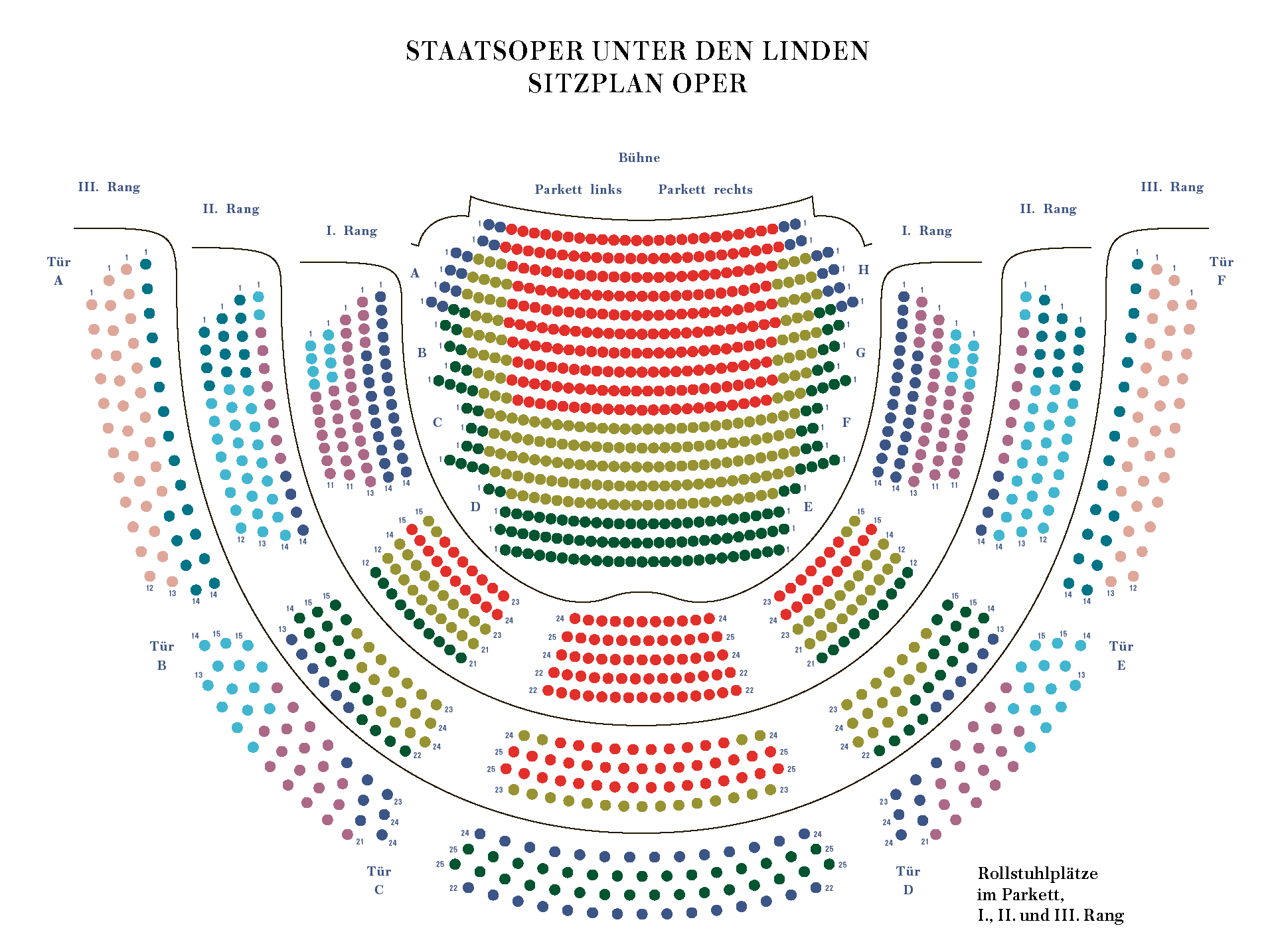
State Opera Unter den Linden
Staatsoper Unter den Linden is one of Berlin's most prestigious opera houses, with a rich history and significant cultural impact.
History:
The Staatsoper Unter den Linden was originally built between 1741 and 1743, under the direction of architect Georg Wenzeslaus von Knobelsdorff. It was commissioned by Frederick II of Prussia and was initially named the Königliche Oper (Royal Opera). The opera house has undergone several renovations and reconstructions, notably after World War II damage. It reopened in 1984, following a major renovation.
Construction:
The original design was characterized by its Baroque style, featuring an elegant façade and a grand entrance. The building was reconstructed in the 1950s and 1980s, maintaining its classical exterior while modernizing the interior. The façade features a classic portico with six Corinthian columns and a prominent central pediment.
Interior:
The interior is known for its opulent and classical design. The auditorium is renowned for its acoustics and grandeur, with luxurious velvet seats and elaborate decorations. The stage and seating areas have been updated to meet modern performance standards while preserving historical aesthetics.
Concerts and Performances:
The Staatsoper Unter den Linden hosts a variety of performances, including operas, orchestral concerts, and ballet. It is home to the Staatskapelle Berlin, one of Germany's leading orchestras. The opera house is celebrated for its high-quality productions and its role in Berlin’s vibrant cultural scene.
JOURNEY
The Staatsoper Unter den Linden has completely barrier-free access due to its excellent public transport connections.
SUBWAY
Hausvogteiplatz (U2)
Museumsinsel (U5)
Stadtmitte (U2, U6)
Unter den Linden (U5, U6)
BUS
Staatsoper (100, 245, 300)
Unter den Linden/Friedrichstraße (100, 147, 245, 300, N6)
PARKING
Q-PARK parking garage Unter den Linden/Staatsoper
Bebelplatz, 10117 Berlin
There are five electric charging stations in the parking garage. Further information can be found here.
The underground car park on Bebelplatz offers disabled parking spaces and direct access to the opera house. On entering the car park between 5.30pm and 11.30pm, the maximum parking fee is €7. To use this tariff, enter your parking ticket in one of the pay machines and the message »Theatertarif« will appear on the display. Please note that it is not possible to use the tariff if you enter the car park before 5.30pm. so it will not be shown on the display. TIP: If you pay the theatre tariff at the pay machine before the event, you can avoid unnecessary waiting after the show.
Gift someone an unforgettable night at the opera. Choose a gift coupon and let them pick the performance they love—music, drama, and world-class artistry, all in one elegant experience.
 en
en 
 de
de it
it fr
fr es
es ru
ru jp
jp ro
ro







 State Opera Unter den Linden
 Wed 03 Mar 2027 - Sun 14 Mar 2027



 RM EUROPA TICKET GmbH
 Call now
 Book now