Rigoletto
Melodrama in Three Acts (1851)
Music by Giuseppe Verdi
Libretto by Francesco Maria Piave after Victor Hugo
Duration: Approx. 2 hours 40 minutes, including one intermission after Act I
Language: Performed in Italian with German and English surtitles
Recommended age: 12 and above
When Victor Hugo’s play Le roi s’amuse was first—and, for the time being, last—performed in Paris in 1832, the production was banned immediately after its premiere. Nearly twenty years later, when Giuseppe Verdi, the composer of the Italian Risorgimento, set out to adapt the work of the revolutionary French writer into an opera, he too encountered the resistance of the censors.
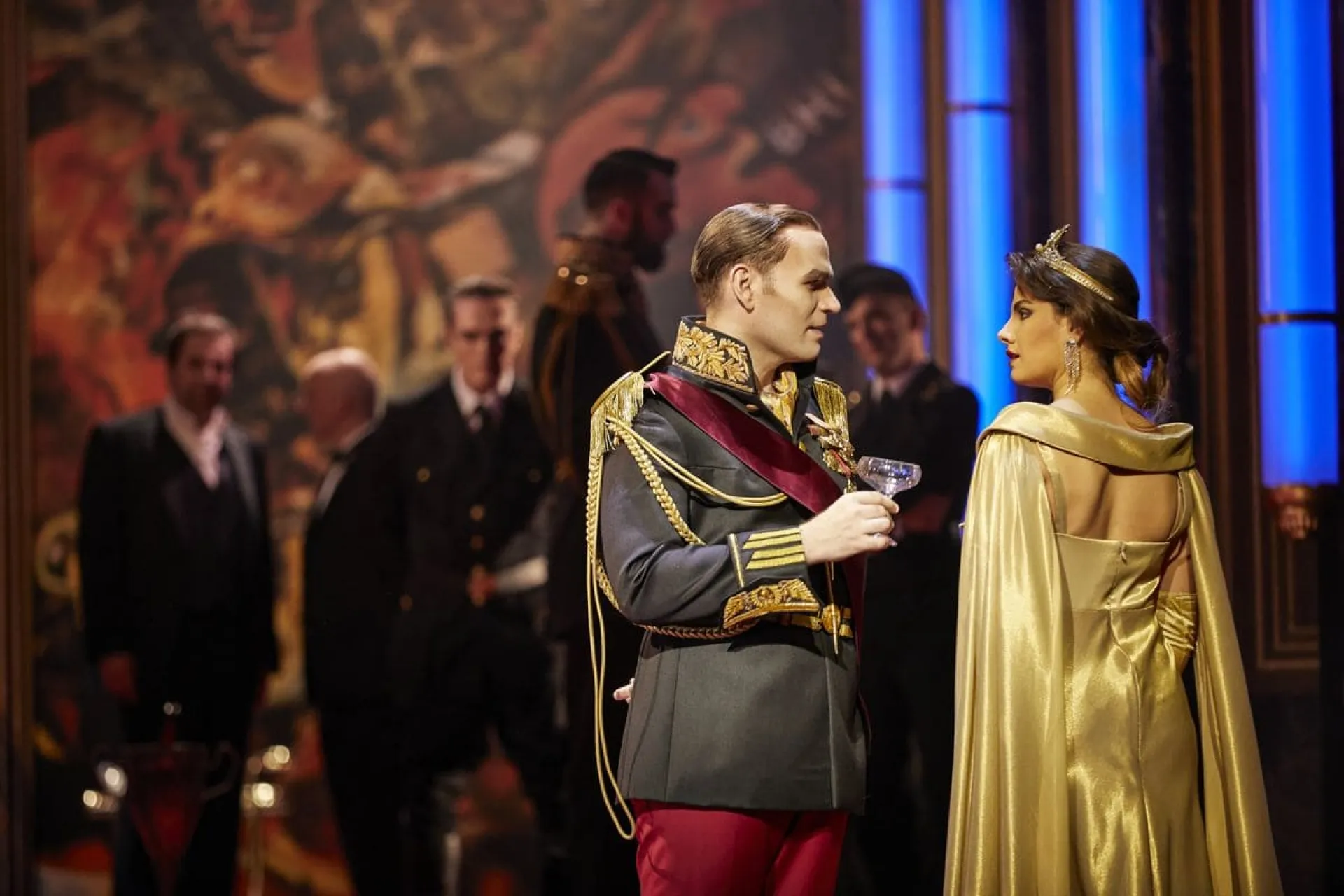
Although he was forced to rename his melodrama from La maledizione (The Curse) to Rigoletto and relocate the action to the court of a fictional Duke of Mantua, Verdi left both the plot and its brutal intensity intact. Rigoletto encourages the licentious Duke in his endless seductions and abductions of beautiful women, showing nothing but mockery toward their families. In return, the desperate father of one of the dishonored women publicly curses him before the entire court. Meanwhile, Rigoletto tries to shield his daughter Gilda from this shameless world. Yet the Duke has already set his sights on her. When Gilda falls victim to the Duke’s powers of seduction, Rigoletto devises a deadly plan of revenge. In the end, however, it is not the Duke but his own daughter who becomes its victim. Ironically, the famous tenor aria La donna è mobile becomes a cynical symbol of failure. In Verdi’s first mature masterpiece, the trivial and the grotesque intertwine with lofty pathos. The striking contrasts between brilliant band music and deeply expressive lyrical melodies create an uncompromising work of genius that overwhelms audiences with extraordinary concision and dramatic force.
Plot
Act one
At one of his lavish parties, the Duke tells the courtier Borsa of a beautiful stranger he has cast his eye upon. But first he dives into the festivities to seek companionship with Countess Ceprano, another object of his desire. Court jester Rigoletto mercilessly mocks Count Ceprano for this. In the meantime, Marullo tells the other courtiers about his discovery that Rigoletto has a secret love. To make his way free for the Countess, Rigoletto suggests that the Duke simply have Ceprano executed, a cynical suggestion that the Duke takes with humor, but Ceprano and the other courtiers demand punishment for Rigoletto. Now Count Monterone crashes the festivities and demands angrily to be heard. But Rigoletto only has ridicule for him, who was convicted of high treason, but only pardoned when his daughter offered the Duke sexual favors. Monterone curses the shameful shenanigans of the duke and his court jester before he is taken away.
Thinking about the curse, Rigoletto makes his way home and on the way meets the hired killer Sparafucile, whose services he declines. Instead, he enters his home where his daughter Gilda awaits him. She knows nothing about her father’s work, not even his name, and is only allowed to leave the house to attend mass, closely guarded by the housekeeper. After a conversation with her about her being his entire family after the death of her mother, Rigoletto departs again. In the meantime, the Duke has bribed Giovanna and thus gets access to the home of the woman he so desires. Gilda remains behind with pangs of conscience, since she has kept it secret from her father that she has seen a young man at church whom she has fallen in love with. In that very moment, he is standing before her in the shape of the Duke, who pretends to be a student named Gualtier Maldé and declares his love for her. Gilda is thrilled. Sounds from outside force “Gualtier Maldé” to leave. There, courtiers are planning to kidnap Gilda, whom they take for Rigoletto’s mistress. When he himself arrives, Marullo pretends that it is the Countess Ceprano they want to abduct. Rigoletto offers his help and only discovers the deception when it is too late and Gilda is already gone.
Act two
The next morning, the Duke is deeply concerned, because when he returned to Gilda last night he was unable to find her. His worries are assuaged when the courtiers report that they have abducted Gilda to the palace. The Duke rushes to meet her. Rigoletto also suspects that Gilda is at the palace and looks for her. He initially pretends indifference in front of the courtiers gloating maliciously. But when a page is denied entry to the Duke’s room, he knows that Gilda is to be found there. In despair, he pleads for her to be released. Finally, Gilda emerges from the room, throws herself into his father’s arms and admits everything. When Monterone is led past on the way to the dungeon, complaining about the ineffectiveness of his curse, Rigoletto makes the decision to force the Duke to pay for the defilement of his daughter.
Act three
Despite everything, Gilda still loves the Duke. At the dive where Sparafucile is holed up, Rigoletto wants to show his daughter the Duke’s real face. Gilda is forced to watch how the Duke has his fun with Sparafucile’s sister Maddalena. Finally, her father insists that she leave town; he will follow later. Rigoletto plans with Sparafucile the murder of the Duke: at midnight, he will personally take the corpse and sink it in the river. Because of an impending storm, the Duke decides to spend the night at Sparafucile’s. Gilda returns, despite their agreed plan, and hears how Maddalena tries to convince her brother to spare the Duke’s life. Sparafucile then declares himself ready to kill the next stranger instead of the Duke and to hand that body to Rigoletto in a sack, if somebody comes. Gilda decides to sacrifice herself for the Duke. When a brief while later Rigoletto picks up the sack with the body to celebrate his triumph, the singing of the Duke from a distance perplexes him. To his horror, he finds the gravely injured Gilda in the sack, she then dies in his arms. Rigoletto is forced to realize that Monterone’s curse has now befallen him.
In Cooperation with the Metropolitan Opera New York
Cast
September 2026
Music Director: Domingo Hindoyan
Production: Bartlett Sher
Set Design: Michael Yeargan
Costume Design: Catherine Zuber
Lighting Design: Donald Holder
Chorus Master: Dani Juris
Duke of Mantua: Ben Bliss
Rigoletto: Simon Keenlyside
Gilda: Elena Villalón
Sparafucile: Alexander Tsymbalyuk
Maddalena: Anna Kissjudit
Giovanna: Rebecka Wallroth
Monterone: Hanseong Yun
Marullo: Carles Pachon
Borsa: Álvaro Diana
Count Ceprano, A Court Usher: Irakli Pkhaladze
Countess Ceprano, A Page: Etīna Emīlija Saulīte
Berlin State Opera Chorus, Berlin State Orchestra
April & May 2027
Music Director: Giacomo Sagripanti
Production: Bartlett Sher
Set Design: Michael Yeargan
Costume Design: Catherine Zuber
Lighting Design: Donald Holder
Chorus Master: Dani Juris
Duke of Mantua: Bekhzod Davronov
Rigoletto: George Petean
Gilda: Marina Monzó
Sparafucile: Taras Shtonda
Maddalena: Anna Kissjudit
Giovanna: Jingjing Xu
Monterone: Hanseong Yun
Marullo: Carles Pachon
Borsa: Álvaro Diana
Count Ceprano, A Court Usher: Irakli Pkhaladze
Countess Ceprano, A Page: Etīna Emīlija Saulīte
Berlin State Opera Chorus, Berlin State Orchestra
Venue
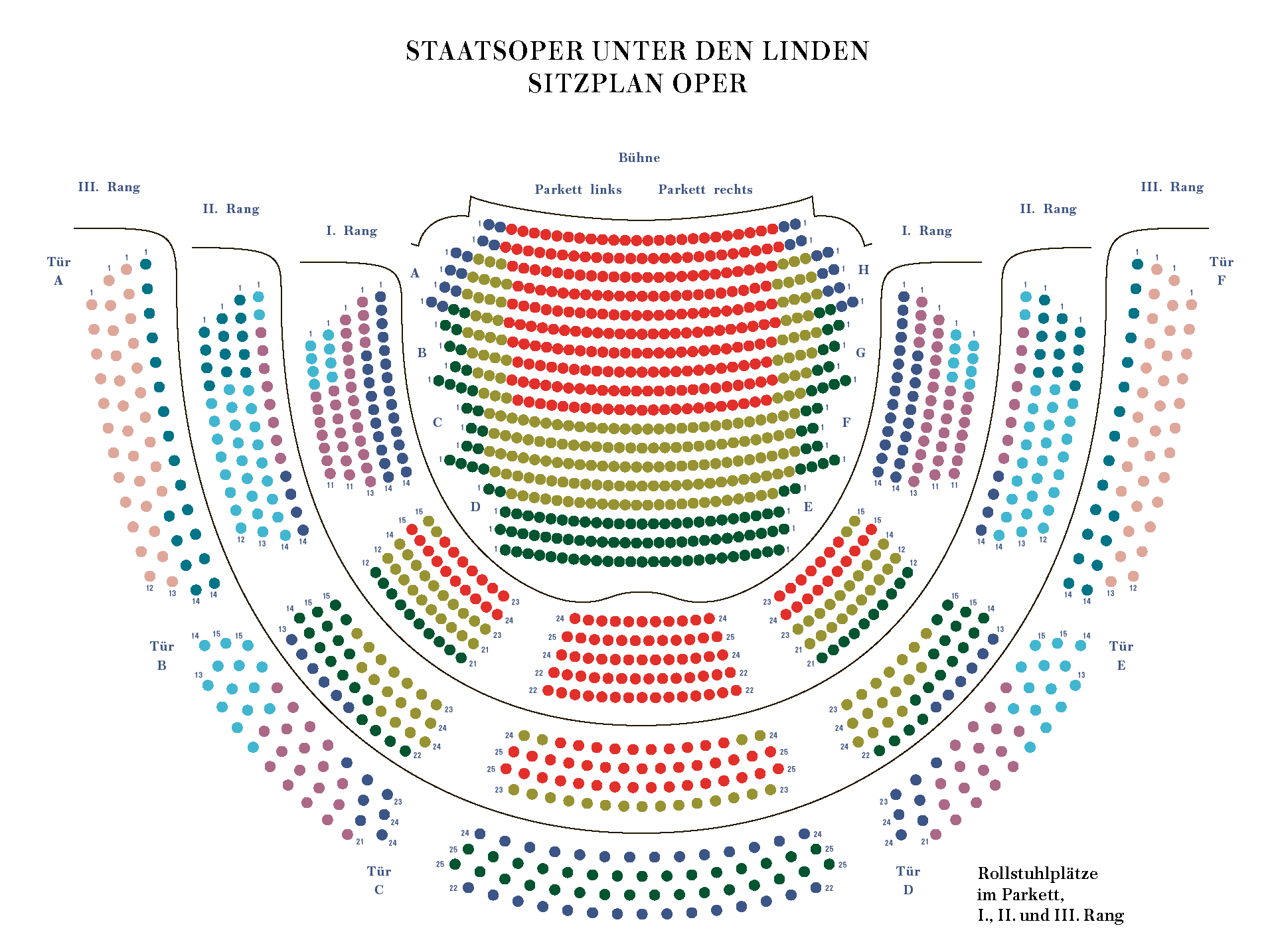
State Opera Unter den Linden
Staatsoper Unter den Linden is one of Berlin's most prestigious opera houses, with a rich history and significant cultural impact.
History:
The Staatsoper Unter den Linden was originally built between 1741 and 1743, under the direction of architect Georg Wenzeslaus von Knobelsdorff. It was commissioned by Frederick II of Prussia and was initially named the Königliche Oper (Royal Opera). The opera house has undergone several renovations and reconstructions, notably after World War II damage. It reopened in 1984, following a major renovation.
Construction:
The original design was characterized by its Baroque style, featuring an elegant façade and a grand entrance. The building was reconstructed in the 1950s and 1980s, maintaining its classical exterior while modernizing the interior. The façade features a classic portico with six Corinthian columns and a prominent central pediment.
Interior:
The interior is known for its opulent and classical design. The auditorium is renowned for its acoustics and grandeur, with luxurious velvet seats and elaborate decorations. The stage and seating areas have been updated to meet modern performance standards while preserving historical aesthetics.
Concerts and Performances:
The Staatsoper Unter den Linden hosts a variety of performances, including operas, orchestral concerts, and ballet. It is home to the Staatskapelle Berlin, one of Germany's leading orchestras. The opera house is celebrated for its high-quality productions and its role in Berlin’s vibrant cultural scene.
JOURNEY
The Staatsoper Unter den Linden has completely barrier-free access due to its excellent public transport connections.
SUBWAY
Hausvogteiplatz (U2)
Museumsinsel (U5)
Stadtmitte (U2, U6)
Unter den Linden (U5, U6)
BUS
Staatsoper (100, 245, 300)
Unter den Linden/Friedrichstraße (100, 147, 245, 300, N6)
PARKING
Q-PARK parking garage Unter den Linden/Staatsoper
Bebelplatz, 10117 Berlin
There are five electric charging stations in the parking garage. Further information can be found here.
The underground car park on Bebelplatz offers disabled parking spaces and direct access to the opera house. On entering the car park between 5.30pm and 11.30pm, the maximum parking fee is €7. To use this tariff, enter your parking ticket in one of the pay machines and the message »Theatertarif« will appear on the display. Please note that it is not possible to use the tariff if you enter the car park before 5.30pm. so it will not be shown on the display. TIP: If you pay the theatre tariff at the pay machine before the event, you can avoid unnecessary waiting after the show.
Gift someone an unforgettable night at the opera. Choose a gift coupon and let them pick the performance they love—music, drama, and world-class artistry, all in one elegant experience.
 en
en 
 de
de it
it fr
fr es
es ru
ru jp
jp ro
ro







 State Opera Unter den Linden
 Sat 24 Apr 2027 - Sun 02 May 2027



 RM EUROPA TICKET GmbH
 Call now
 Book now